Nearly every bathroom we get called into for a "refresh" is structurally fine. The waterproofing is doing its job, the layout is sensible, the plumbing is where it should be. What has aged is the surfaces you look at, and those are a different order of job entirely.
Australians are also redoing bathrooms sooner than they used to. The Housing Industry Association put the bathroom refresh cycle at 17 years before the pandemic and under 14 years by 2022. A bathroom now starts feeling dated well before anything in it has actually failed, and that is a very different problem to fix.
What actually makes a bathroom look dated
Stand at the door and look at it honestly. In almost every case it comes down to four things, and none of them are the layout:
- Grout and silicone. Dark, patchy grout ages a room faster than anything else in it. It reads as dirty even when it is clean. Worth knowing: NSW Fair Trading's own Guide to Standards and Tolerances says silicone sealant "may require replacement after five years" and that this is "normal house maintenance which is the owner's responsibility." Perished silicone is not a defect and not a sign the bathroom is failing. It is a consumable, and it is on a roughly five year clock.
- The vanity and its hardware. A 1990s cabinet with round chrome knobs dates a room instantly, even when the benchtop is fine.
- Paint and the ceiling. Bathroom ceilings take steam every day. They go patchy and yellow long before the walls do.
- Tapware, towel rails, the mirror, the light. Small metal things, all visible, all reading as old at once.
Notice what is not on that list: the position of anything. If your shower, toilet and vanity are in sensible places, you are looking at a cosmetic problem wearing a renovation costume.
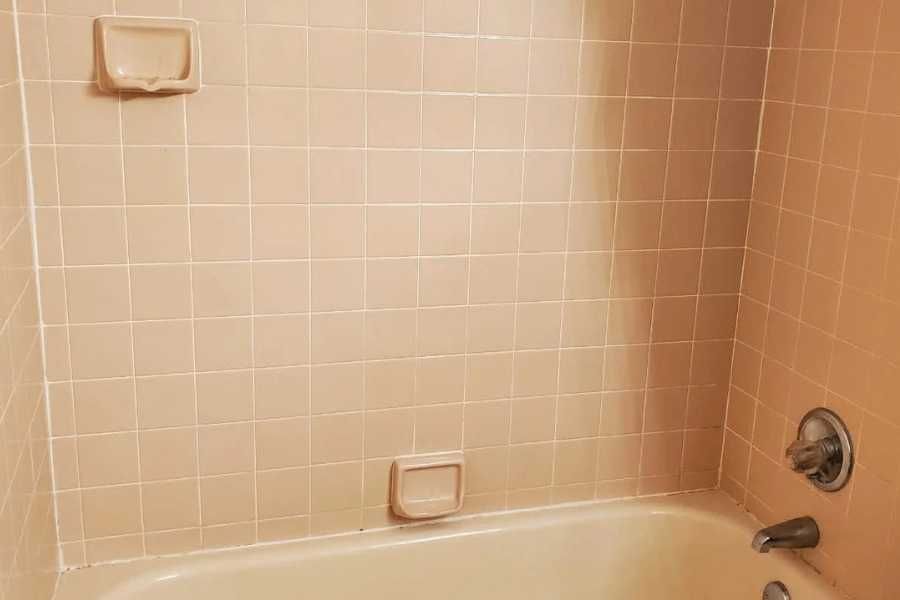 Apricot tile, original to the house
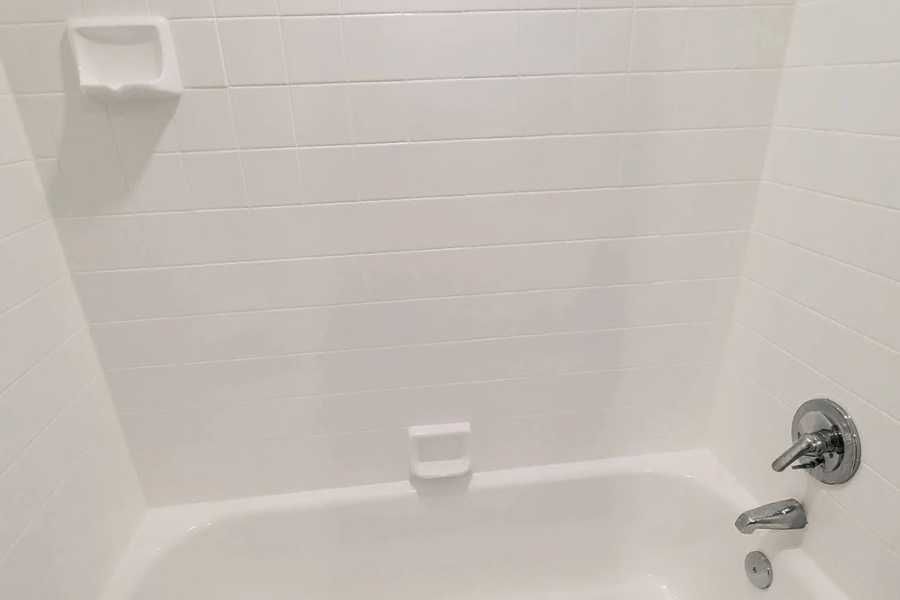 The same tiles, resurfaced
The five minute check most people skip: your exhaust fan
Before you spend anything on how the room looks, look up. Under the National Construction Code, a bathroom exhaust fan has to discharge to outdoor air, not into the roof space. It must move at least 25 litres per second. And if the room has no window, the fan has to be interlocked with the light switch and run on for ten minutes after you turn the light off.
Venting into the roof cavity is extremely common in older Sydney houses, and it is the reason a bathroom keeps growing mould no matter how often it is cleaned. You are not fixing that with paint. If you are renting it matters more again, because adequate ventilation is one of the seven minimum standards a NSW rental has to meet, and mould caused by inadequate ventilation sits with the landlord rather than the tenant.
What a handyman can change in a day
Working front to back, these are the jobs that do not touch the waterproofing and do not need the room demolished:
- Raking out and replacing tired grout, and re-siliconing the internal corners and the floor junction. Biggest visual change per dollar in most bathrooms, and it is tiling work rather than a renovation.
- Repainting the ceiling and any painted wall in a proper bathroom-grade product. Steam is unforgiving, so the preparation matters more than the paint does.
- Patching and setting water damaged plasterboard above the shower or around an exhaust fan before it gets painted, which is plastering.
- Swapping tapware, towel rails, the mirror and the shower screen seals.
- Replacing or reworking the vanity cabinet and its doors, which is carpentry once a licensed plumber has disconnected the water.
- Rehanging or adjusting the door if it has dropped and catches on the floor, which is a door repair.
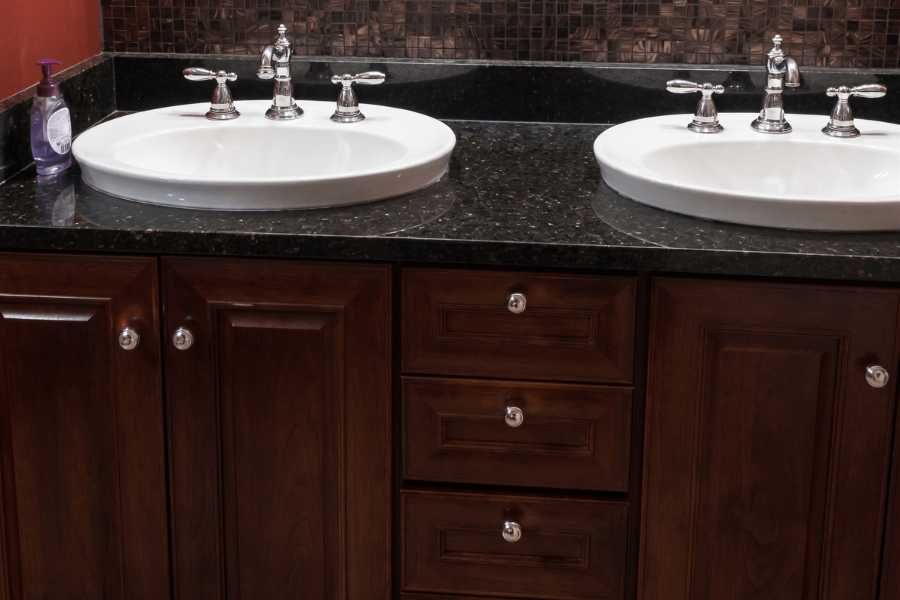 Dark timber, sound but dated
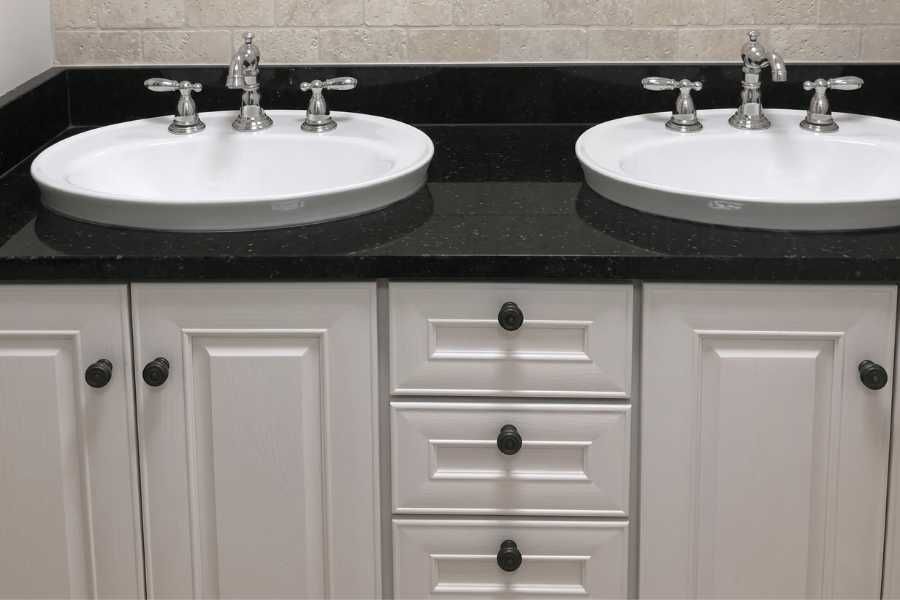 The same cabinet, refinished
Roughly what these jobs cost in Sydney
We price your job in writing rather than off a chart, but you should go in with a rough shape of the numbers. These are indicative Sydney ranges, not a quote, and the spread is wide for a reason: what you pay depends on access, condition and how much preparation the job actually needs.
- Repainting a bathroom: roughly $400 to $900 for a small bathroom done properly, ceiling included. The cheap end of the market skips the preparation, and in a room that steams up every day that shows within a year.
- Regrouting: commonly $800 to $1,200 for a shower, or a full reseal and regrout toward the upper end. Priced per job rather than per square metre by most Sydney operators, because the raking out is the work, not the grout.
- Replacing bath or basin tapware: the tapware itself, plus a licensed plumber, who will generally be $100 to $150 an hour in Sydney with a minimum call-out.
- Removing and replacing an existing shower screen: roughly $300 to $500 in labour, plus the screen.
- A full Sydney bathroom renovation generally lands somewhere in the high teens to mid thirties of thousands. We are being vague on purpose: anyone quoting a single confident number for a bathroom they have not seen is guessing.
The gap between that last line and everything above it is the entire argument for a refresh.
While the tapware is off, check the flexi hoses
This is the one job on the list that is not cosmetic at all. Suncorp analysed more than 22,000 home insurance claims from 2024 and found one in ten water damage claims came from a burst flexible hose, at an average of more than $27,500 a claim. Of the hoses they inspected, 30 per cent were at risk of bursting. A burst hose left overnight can release enough water to fill a swimming pool.
There is no fixed replacement interval, and Suncorp are careful not to give one: some last twenty years and some corrode early. But when the taps are already off is the cheapest moment in the life of a bathroom to have someone look at them.
What is not worth touching if it still works
There is a strong temptation, once you start, to keep going. Resist it in three places:
- Waterproofing that is not leaking. If there is no damp in the room below, no swelling at the door architrave and no mould that returns within days of cleaning, leave it alone. Opening up a working wet area is how a cosmetic job becomes a renovation.
- The layout. Moving a toilet or a shower waste means the floor comes up. That is the single decision that turns a few days into several weeks.
- Sound tiles you simply do not like. Removing tile that is well stuck usually damages the substrate behind it, and now you are repairing something that was not broken.
One honest note on age. The Australian Standard for waterproofing domestic wet areas, AS 3740, first appeared in 1989 and has been revised five times since, most recently in 2021. A bathroom waterproofed before 1989 predates a dedicated standard entirely. That is not a reason to rip it out while it is working, but it is worth knowing before you open anything up, because what you find may not be what you would install today.
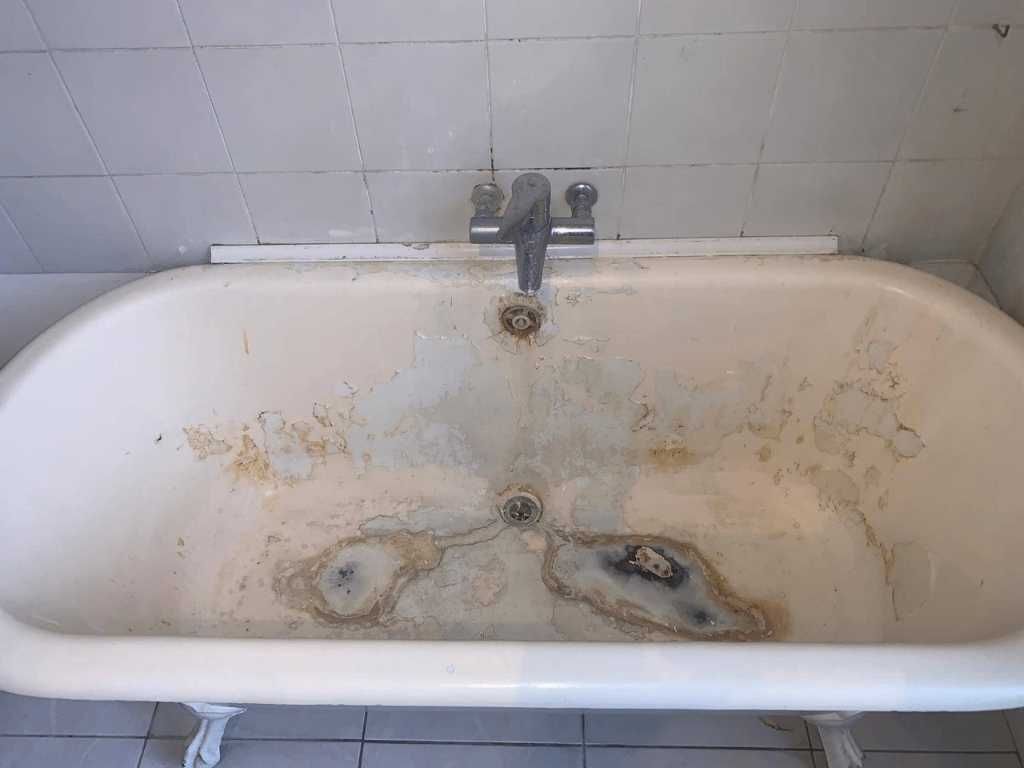 Stained, but structurally sound
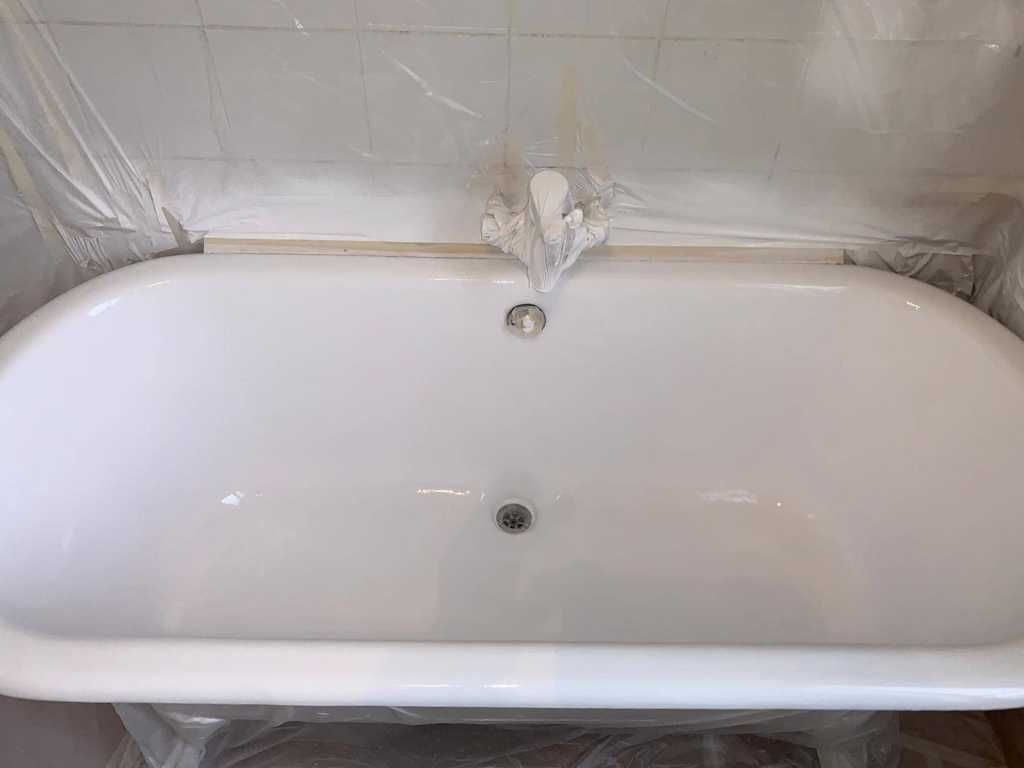 The same bath, resurfaced
The bath and the tile finish: resurface, do not replace
This is the part of a bathroom refresh that saves the most money, and it is the part most people do not know exists.
If your bath is structurally sound but the enamel is stained, chipped or simply the wrong colour, replacing it is a serious job. The bath is usually built into the tiled wall, so taking it out means taking tile with it, which means the wet area is open, which means waterproofing, which means you have accidentally started a renovation over a bath that was never actually broken.
The alternative is resurfacing: the existing bath or tile is prepared and refinished in place, so nothing comes out and the wall stays shut. It is a specialist trade with its own materials and preparation, which is why we bring in a specialist for it rather than a general hand. For bathrooms we work with Timeless Resurfacing, who resurface baths, tiles and vanities across Sydney. The photographs above and below are their work.
What can be resurfaced rather than replaced
Most people only know about baths. The same approach covers most of the hard surfaces in a bathroom, which is why it is worth asking before you price a replacement:
- Baths, including cast iron and claw foot, stained, worn or the wrong colour. Bath resurfacing.
- Chips and cracks in an otherwise good bath, which are repaired on their own without refinishing the whole thing. Chipped bath repair.
- Basins and sinks that are chipped or have gone dull. Basin restoration.
- Vanity cabinets where the carcass is sound and only the finish has dated. Vanity refinishing.
- Wall and floor tiles, including the apricot and dusty pink that came with a lot of Sydney houses. A whole room is generally $3,000 to $4,000 and up. Tile resurfacing.
The common thread is that the item underneath is sound. Resurfacing does not fix a cracked bath, a failed membrane or a tile that has let go of the wall, and a good operator will tell you that before quoting.
For scale, in Sydney, and it goes up in steps depending on how much of the room you do:
- One bath: about $1,200 to $1,700. More for cast iron or a claw foot.
- Wall and floor tiles: about $3,000 to $4,000 and up, depending on the size of the room and the condition of what is under the coating.
- The lot, bath and basin and shower and all the tiling: $10,000 and up.
Worth being straight about what that last figure means. A full renovation is generally the high teens to mid thirties of thousands, so doing the entire room in one go is not a tenth of the price, it is closer to half. What you are actually buying at that level is the things a renovation costs you beyond money: the wet area never gets opened, the waterproofing is never disturbed, the plumbing does not move, and you are not without a bathroom for weeks. If you only need the bath done, you are at the top of this list, not the bottom, and that is where the saving is enormous.
If you are quoted well under those figures, ask what preparation is included. The price gap between a resurfacing job that lasts and one that peels inside a year is almost entirely preparation. Australian resurfacing firms typically warrant the work for five to seven years. That is a warranty period rather than a life expectancy, and anyone quoting you a confident number of years the finish will last is guessing.
The same logic applies to a vanity you like the shape of but not the colour. Where the cabinet is sound and it is only the finish that has aged, refinishing the vanity instead of replacing it avoids disconnecting the plumbing at all, which is usually the expensive part of a vanity swap.
Renovating it versus resurfacing it
| Full renovation | Resurfacing the existing | |
|---|---|---|
| Typical cost | High teens to mid thirties of thousands, per published Sydney guides | About $1,200 to $1,700 a bath, $3,000 to $4,000+ for the tiling, $10,000+ for the whole room |
| Room out of action | Weeks | Usually back in use the next day |
| Demolition | Yes, and the wet area is opened up | None. The wall stays shut |
| Waterproofing | Has to be redone to AS 3740 | Untouched, so nothing to re-certify |
| Changes the layout | Yes, if you want it to | No |
| Best when | The layout is wrong, or water is getting through | Everything works and it simply looks tired |
Cost figures are other people's published guide prices, not our quotes. Renovation guides disagree with each other by roughly a factor of two, which is its own argument for pricing your actual job rather than trusting a chart.
What legally needs a licensed trade in NSW
Some of this is not a matter of skill or preference, and one part of it is widely reported incorrectly.
Plumbing, electrical and gas work require a licence at any value. It does not matter if the job is worth fifty dollars. That covers disconnecting a vanity, changing a mixer, and moving a light, a heat lamp or an exhaust fan.
Everything else is governed by a dollar threshold, currently $5,000 in labour and materials including GST. Below that, general trade work does not require a contractor licence in NSW.
Here is the part most bathroom articles get wrong: waterproofing is not "specialist work" in NSW. NSW lists it as general trade work alongside carpentry and painting, so the $5,000 threshold applies to it rather than a licence at any value. We are telling you that because it is what the rules actually say, not because we think it is a good idea to have waterproofing done by whoever is cheapest. Legal and advisable are different questions, and the work still has to comply with the National Construction Code and AS 3740 no matter who does it.
Two more things worth knowing before you sign anything: over $5,000 the work needs a written contract, and above $20,000 the contractor must hold Home Building Compensation cover and cannot legally take a deposit without it. Statutory warranties run six years for major defects and two years for everything else.
Note also that the $5,000 figure has been under review in NSW for some time, so treat it as current rather than permanent.
If it is a rental, the tapware is a legal question
Landlords should know this one before buying a tap. To pass water usage charges on to a tenant in NSW, the property has to meet water efficiency requirements: shower heads and internal cold water taps and mixers at bathroom basins rated at no more than 9 litres per minute, dual flush toilets at a minimum 3 star WELS rating since 23 March 2025, and no leaking taps or toilets anywhere on the property.
Fit a good looking basin tap that runs at more than 9 litres a minute and you have just lost the right to bill your tenant for water. It is a small detail with a recurring cost attached, and it is the kind of thing worth asking your tradesperson about rather than discovering later.
When a refresh is the wrong call
Sometimes the answer really is a renovation, and it is not fair to talk you out of one. Renovate if:
- There is active water getting through. Damp on the ceiling below, a swollen door frame, or mould that returns within a week of being cleaned properly. NSW Fair Trading's guidance is blunt about the cause: wet areas "mainly fail because of poorly installed waterproofing membranes and incorrect detailing," and that is not a cosmetic fix.
- The layout genuinely does not work for the household, rather than simply looking old.
- The tiles are drummy over a large area, which means they have let go of the substrate and are not going to be saved by anything cosmetic.
- You are about to sell and the agent has told you the bathroom is holding the price back. That is a commercial decision, not a maintenance one.
If none of those apply, start with the four surfaces at the top of this page. It is a fraction of the cost, the room stays usable, and you can always renovate later. The reverse is not true.
Sources: NSW Fair Trading Guide to Standards and Tolerances (2017); NSW Government licensing and rental pages (retrieved July 2026); National Construction Code 2022 Housing Provisions Part 10.8; Suncorp flexi hose claims analysis (2025); Housing Industry Association. Prices are indicative ranges for Sydney and are not a quote. Yours gets priced in writing.