You have looked at the driveway and decided it has to be done. Before you book anyone, work out which of those marks are actually going to lift. Used well, a pressure washer takes a driveway back to the colour it was poured. Used badly it etches the concrete permanently, drives water in behind cladding, and strips the sand out of paving joints so the whole path starts moving.
What will actually come off
- Dirt, dust and general grime.
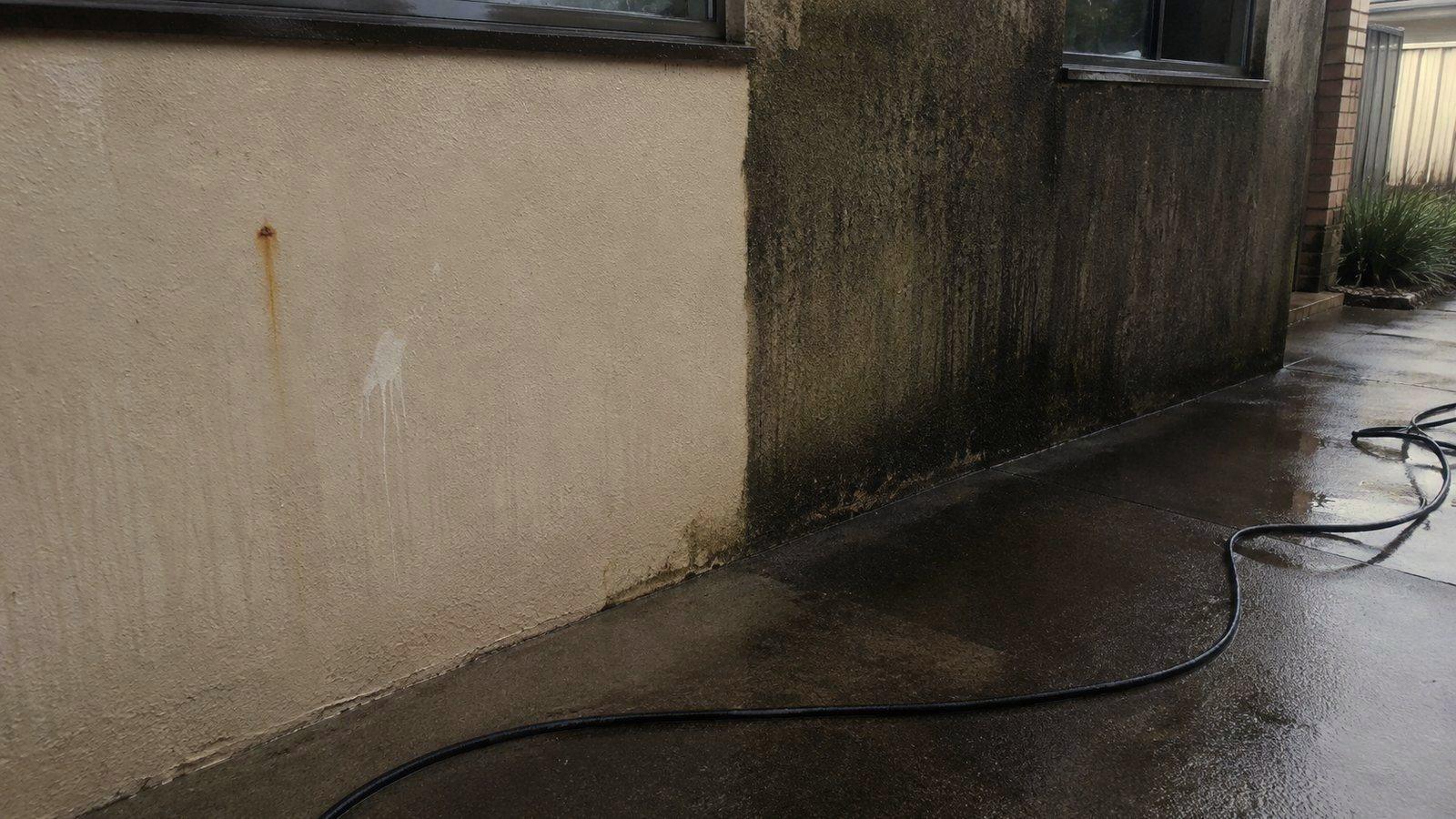
- Algae, moss and lichen, which is most of what makes concrete look green or black in a shaded spot.
- Loose efflorescence, the white powdery bloom on paving and brick.
- Cobwebs, leaf staining and the dark film on a wall that never gets sun.
- Fresh spills on a sealed surface.
What is staying, whatever the pressure
- Oil that has soaked into porous concrete. It fades, it does not leave.
- Rust staining from a steel post, a pot or reinforcement. That is in the concrete.
- Paint that has been walked into a slab.
- Tyre marks that have melted into a hot driveway.
- Anything that has changed the colour of the concrete rather than sitting on it.
A contractor who tells you an old oil stain will come out with pressure is either guessing or is hoping you will not check. It fades, sometimes noticeably, and then it is still there.
Hard surfaces are high pressure cleaning. Render, eaves and painted cladding want soft washing render and eaves instead.
Ask before the job which marks are expected to come out and which are not. A straight answer before the work is worth more than an apology after it.
The tip and the distance do the damage, not the pressure
Three things decide what a pressure washer does: the pressure, the tip, and how close you hold it. A narrow zero degree tip held close will cut a line into concrete, and that line is permanent. A wide fan at exactly the same pressure will not. Nearly all the damage you see on a driveway is a tip and distance problem.
On open concrete a flat pressure washer head is the right tool, because it keeps a constant distance and there are no wand stripes. Wand stripes across a driveway are the tell that someone did it by hand and did it quickly.
Render, decking and roof tiles want a soft wash
Rendered walls, painted surfaces, fibre cement cladding, timber decking and roof tiles all want a lower pressure and, usually, a soft wash approach where the chemistry does the work and the water rinses it off. High pressure on render takes the render. High pressure on a roof drives water under the tiles.
The dirty water has to go somewhere
A driveway wash makes a lot of it. In this part of Sydney that usually means the street gutter and then the stormwater system. Wet the garden beds down before you start so run off does not soak in concentrated, and rinse them afterwards. If chemicals are going on a commercial site, where the water ends up is a real consideration and worth agreeing before the job.
Two to three years between cleans
That is what most open driveways around Sydney hold for. A shaded or south facing surface, or anything sitting under a tree, is closer to yearly. Sealing decorative concrete or paving after a clean roughly doubles how long it stays looking clean, and it is a separate job worth pricing separately.